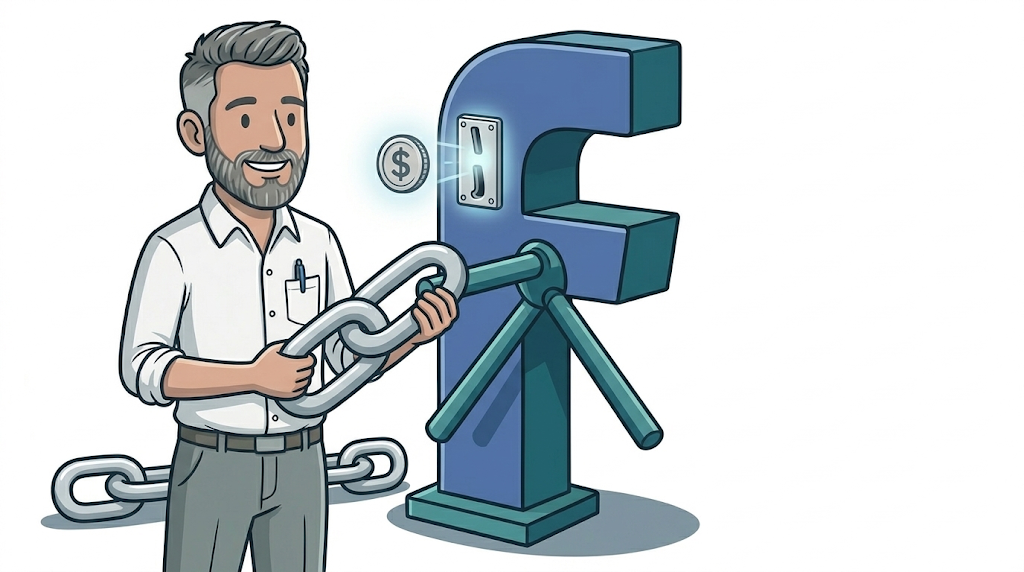
Facebook charging for link posts is no longer a rumour buried in a help document. If you run a Facebook Page for your business, you may have noticed something new this month. Meta is limiting how many posts with links you can publish for free. As of this week, non-paying Facebook Pages are capped at two link posts a month. Want to post more links to your website, your booking page or a blog update? Meta wants you to pay for a Meta One for Business subscription to do it.
This is rolling out now, on the back of a similar restriction Meta first trialled in December 2025, and it is worth five minutes of your time to understand, whether or not it ends up affecting your Page.
What actually changed
Meta One for Business launched this month with four paid tiers, priced in US dollars where it has been observed so far. Meta has not confirmed UK pricing or a full UK rollout yet. The free tier gives you two link posts (or link comments) a month across Facebook. If you want more, the tiers run from around $15 a month for Basic, still capped at two links but with other perks, up to around $500 a month for Premium, which removes the Facebook link cap entirely and allows up to 12 Instagram Reel links a month.
A few things are exempt from the count, so they are worth knowing if you post regularly:
- Links added as a comment under a post that already has one
- Links to Meta’s own platforms (Instagram, WhatsApp, Threads)
- Facebook affiliate links
- Any link inside a paid advert
- Publisher Pages, the news and media accounts Meta relies on for content, which are exempt entirely
Why Meta is doing this now
It is tempting to read this as Meta squeezing small businesses for cash, and there is certainly an element of that. But Meta’s own data gives useful context. By its own reporting, external links made up under 2% of what people actually saw in their feeds during the first quarter of 2026, down from close to 10% back in 2022. The algorithm has been quietly burying link posts in favour of native content (video, photos, text updates) for years. This change does not really take anything away from most Pages. It monetises a habit Facebook had already made close to pointless.
That is the real story here, and it is one GLC has been saying for a while. Organic reach on rented platforms has been shrinking steadily, and this is just the next visible step.
What this means for your business
If you are a sole trader or small business that occasionally shares a link to a new blog post, a special offer or a booking page on your Facebook Page, two things are worth checking now.
First, work out whether your account is actually in the affected group. Meta has described this as a limited, region-by-region test, so it may not have reached your Page yet, and it is not worth paying for a tier you do not need before you have confirmed you are restricted.
Second, and more importantly, do not treat this as a Facebook problem to solve with a Facebook subscription. If two free links a month feels tight, that is a sign your business is leaning too heavily on a platform you do not own and cannot control the rules of. The exemption for adverts is telling. Meta is happy for you to link to your site all you like, as long as you are paying to promote the post. Organic traffic is being nudged towards the checkout.
For local service businesses in particular (dog walkers, tradespeople, coaches, anyone who posts regularly to keep their community updated) this is a reminder that Facebook should be one channel feeding people back to a website you control, not the only place your business exists online. We wrote about that in more detail for website design for dog walkers, and the same idea applies to any local trade. We touched on a similar theme when Threads quietly removed link click tracking a few weeks ago. Platforms keep changing the rules on the traffic you send them, but they cannot touch the traffic that already lands on your own site through search or a well-run ad campaign.
What to do about Facebook charging for link posts
A few practical steps if this affects you:
- Check your Page’s posting tools for a link post counter before you assume you are restricted.
- If you do hit the limit, save your two free links a month for the posts that matter most, a big offer or a genuine announcement, rather than routine updates.
- Consider whether a small, well-targeted Meta ad budget makes more sense than an ongoing Meta One subscription. Adverts are not capped, and unlike a subscription, ad spend is directly tied to reach you can measure. That is the kind of measured spend we build into our Google and Meta ads service.
- Longer term, make sure your website itself is doing the job of converting visitors, not just Facebook. A page that ranks well in Google search and converts on arrival needs Facebook a lot less.
Frequently asked questions
Is Facebook charging for link posts on every Page?
Not necessarily. Every professional Page gets two free link posts a month. You only need Meta One for Business if you regularly post more than that, and only if the cap has reached your Page.
Does this affect Facebook ads?
No. Links inside paid adverts are exempt from the count entirely, along with links to other Meta apps like Instagram and WhatsApp.
Is this rolled out everywhere yet?
Not confirmed as global. Meta has described it as a limited test expanding from a December 2025 trial, so check your own Page’s posting tools rather than assuming you are affected. UK pricing has not been confirmed either.
Should I just stop using Facebook for my business?
No, but this is a good prompt to check your website is doing the heavy lifting, not your Facebook Page. Facebook is still useful for community and visibility. It should not be the only place people can find or contact your business.
An easy first step
Changes like this land on our desk every week, which is exactly why we keep an eye on them so you do not have to. If this has made you wonder whether your own website is pulling its weight, we will design you a free website with no obligation to go further so you can see what a site built to convert, not just exist, actually looks like. Every website we build is set up to be found in search and to convert on arrival, so Facebook becomes one useful channel rather than the only place your business lives.
And if paid social is part of your plan, our Google and Meta ads service is built to make sure that spend is measured properly, not just guessed at.
Contact Gareth at GLC Web Solutions to check whether your website is doing the heavy lifting, or whether you are still renting your whole online presence from Facebook.