On 2 September, Anthropic (the company behind the Claude AI models) released something called “Commerce Agents” — free, open-source blueprints that let any developer build an AI agent that can browse product catalogues, compare prices, fill a shopping cart, and hand it off for checkout. A day later, coverage from MarkTechPost confirmed the code works across retail, travel, telecoms and entertainment, and runs on nothing more exotic than a standard developer laptop and an API key.
If that sounds like something only Amazon-sized retailers need to think about, I’d have said the same a year ago. But the direction of travel matters more than the release itself, and it’s worth five minutes of a busy owner’s time to understand why.
What Anthropic actually announced
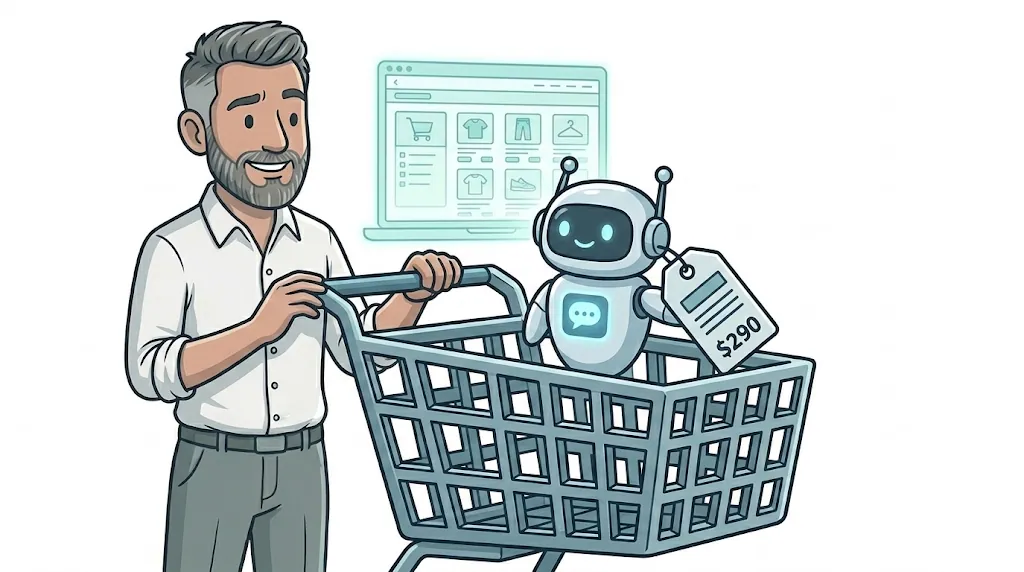
The blueprint ships two types of agent. A “shopping agent” does the browsing on a customer’s behalf — searching catalogues, comparing options, building a basket. A “merchant agent” sits on the business side, handling things like inventory and pricing logic. Notably, Anthropic left payments and checkout out of it entirely — no money moves through Anthropic’s systems, and transactions still run through a retailer’s existing payment setup (Visa, Mastercard, whatever you already use). According to Anthropic’s own reporting, cited by PYMNTS, retailers piloting the agents saw carts grow up to 35% larger and shoppers were 60% more likely to complete a purchase — figures worth treating as an early, self-reported signal rather than a guarantee, but a signal all the same.
This isn’t a finished product a small business can switch on tomorrow — it’s scaffolding aimed at developers. But it’s the clearest evidence yet that the big AI labs expect AI agents doing the “browsing” and “comparing” part of shopping to become normal, not niche.
What this means if you’re not a big retailer
You don’t need to build an AI agent to be affected by this. The more relevant question is: if an AI agent — a customer’s ChatGPT, Claude, or Gemini assistant — goes looking on a customer’s behalf, can it actually understand your website?
Agents (and the AI Overviews and AI Mode features already built into Google) work by reading a page’s actual content and structured data, not by “seeing” a page the way a person does. A site with clear product information, accurate prices, working stock status, and clean underlying code is legible to an agent. A site that’s all images and vague copy, or one where prices live only in a PDF price list, effectively doesn’t exist to it.
This is a continuation of a trend GLC has covered before with GEO (generative engine optimisation) — it’s the same fundamentals, applied to a slightly different use case.
What to actually check on your own site
A few concrete things worth checking now, none of which require an AI agent to exist yet:
- Product and service pages have real text, not just images — names, prices, availability, and specifics, in HTML that can be read, not baked into a graphic.
- Structured data (schema markup) is in place for products, services, and pricing, so search engines and agents alike can parse what you’re selling without guesswork.
- Prices and stock are accurate and current — an agent (or a person) landing on an out-of-date price is a trust problem, not just an SEO one.
- Checkout and contact paths still work simply for a human who lands after an AI-assisted search, since Anthropic’s approach — and the wider industry data on in-chat checkout underperforming — both point to purchases still finishing on the business’s own site.
Frequently asked questions
What is an AI shopping agent?
Software that browses websites, compares products or services, and builds a shopping basket on a person’s behalf — using an AI model like Claude, ChatGPT or Gemini to do the “looking around” part a person would normally do themselves.
Do AI agents actually buy from small business websites yet?
Not routinely, and Anthropic’s own release deliberately leaves payment and checkout out of it. What’s changing is the browsing and comparing stage — which makes how clearly your site presents information more important, not less.
Do I need structured data for AI shopping agents to find me?
It helps considerably. Structured data (schema markup) is the clearest way to tell an AI system exactly what you sell, for how much, and whether it’s in stock, rather than leaving it to interpret images or loosely worded copy.
Is this only relevant to online shops?
No — the same legibility principle applies to any small business site, whether you’re selling products, taking bookings, or just want an AI-generated answer to accurately describe your services and prices.
Where GLC fits in
None of this means overhauling your website overnight. It means the businesses whose sites are clean, accurately structured, and easy to parse — by people and by AI systems alike — are the ones best placed as this shift continues. That’s exactly the groundwork covered in GLC’s SEO & GEO audits, and it’s built in from the start on every site we design (see website design and development).
If you’re not sure where your own site stands, it’s worth reading our earlier guide on optimising your website for GEO, or, for an easier first step, take up GLC’s free, no-obligation website design offer — a good excuse to get a second pair of eyes on how your site actually reads, to a person and to a machine.
Contact Gareth at GLC Web Solutions to review whether your product and service pages are actually readable to search engines and AI agents — and what to fix first.