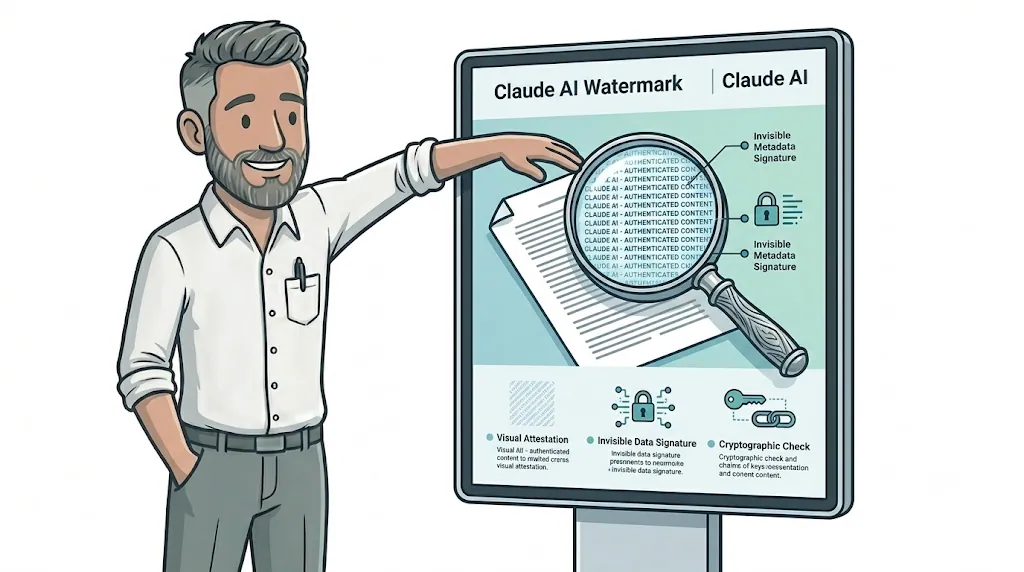
Anthropic has started marking Claude’s output in a way you cannot see. From August 2026, supported Claude models weave a statistical watermark into generated text, and attach cryptographically signed provenance metadata to supported image files. The trigger is the EU AI Act’s transparency rules — but Anthropic is applying the marks worldwide because it cannot yet scope them by region.
That is a bigger moment than another product changelog. A large share of businesses have quietly moved from “AI as a drafting assistant” to “AI as the content department”. If your publishing model is paste, publish and hope, a machine-readable mark — and a wave of detectors that will follow — changes the risk profile of that habit. Not because Google has banned AI. It has not. Because the web is about to get much better at asking whether anyone actually did the work.
What Claude’s watermark actually is
It is not a faint logo behind the paragraph. Anthropic uses a version of Google DeepMind’s SynthID-Text approach: when the model chooses among several equally good next words, it uses a keyed pattern instead of an arbitrary random draw. Over a long passage those choices add up to a signal. A reader cannot see it. There are no hidden characters and no extra tokens — so it does not cost more to run.
Two other facts matter for publishers:
- The mark is about Claude’s involvement, not about you. Anthropic says it cannot be traced to a person, organisation or chat.
- A detected mark is a probability, not a courtroom stamp. It cannot tell “Claude wrote this” from “Claude heavily edited this”. Short passages, tightly factual sentences and code leave less room for the watermark to attach.
For images, the mechanism is different: signed C2PA content credentials in the file metadata — a note that Claude created or processed the file, not a pattern baked into the pixels.
Anthropic has said a detection API is coming. Other major model providers signed the same EU Code of Practice. Expect a messy year of overlapping watermarks, not a single “AI or not” light on every page.
Why this is significant if you have outsourced writing to a model
Until now, “was this written by AI?” lived in the land of vibes and third-party classifiers. Those tools guess from style — favourite constructions, evenly polished sentences, a suspiciously calm vocabulary. Claude’s watermark is a different class of evidence: it is applied at generation time by the model provider, with a key.
If your content pipeline is “prompt → paste into WordPress → rank”, you have been betting that nobody could prove the shortcut, and that Google would not care. The second half of that bet can still be true. The first half is getting weaker.
This is significant for three practical reasons:
- Trust becomes inspectable. Clients, journalists, universities and platforms will eventually have a button. “We used AI for research” is a grown-up answer. “We published 80 location pages nobody in the business could defend” will not be.
- GEO cares about citable sources. Generative engines prefer pages they can treat as a source, not another remix of the same model sludge. If the open web is increasingly labelled as processed by a frontier model, undifferentiated AI blogs become even less useful to quote.
- Editing is not laundering. Anthropic is clear that light edits often leave the watermark in place. A full rewrite, where every word is replaced, can remove it — at which point you have done the work the model was supposed to skip.
Google does not ban AI. It bans the business model of slop
Google’s Search Central guidance has been consistent since 2023: using automation, including AI, to generate content primarily to manipulate rankings is spam. Using AI to help produce useful, original, people-first pages is not against the guidelines. AI does not get a ranking bonus. It is just content. If it demonstrates experience, expertise, authoritativeness and trust — and it actually helps the searcher — it can do well. If it is interchangeable filler, it will not, whether a human or a model typed it.
Be realistic about what that means in 2026:
- There is still no public “Claude watermark ranking factor”. Do not rewrite your strategy around a leak that has not happened.
- There is a sitewide quality problem when dozens of thin, lookalike pages exist mainly to capture queries. Helpful-content thinking now sits inside core ranking, not as a one-off update you can wait out.
- AI Overviews and other generative answers reduce clicks on generic explainers. Pages that only restate what a model already knows are the first to become invisible — watermark or not.
- If search engines, browsers or social platforms start surfacing provenance at scale, unlabelled mass generation becomes a reputation issue even when it is not a hard penalty.
The honest ranking impact is this: AI will not sink a page that a real specialist would be proud to put their name on. Relying solely on AI to industrialise average articles will look more and more like the scaled, unoriginal content Google has been trying to demote for years. The watermark just makes the industrialisation easier to talk about.
Measure the work. Do not worship a detector score
If you take one operational lesson from this, make it measurement — of outcomes, not of “% human”.
Track whether pages earn impressions and clicks in Search Console, whether they pick up non-brand queries, whether they are valid in the index, and whether people who land actually enquire. For GEO, track whether your brand is cited in AI answers for the questions you care about. Those numbers tell you if the content is doing a job.
An AI-detector percentage does not. Treat it as a noisy secondary signal at best.
Why a grammar check can get you falsely marked as AI
Here is the part many teams will get wrong. They will run every draft through Grammarly, Hemingway or Claude-as-proofreader, then panic when Originality.ai, GPTZero or a CMS plugin screams “AI generated”.
Those classifiers are not reading Anthropic’s key. They are scoring how the text looks: uniform sentence length, tidy transitions, low burstiness, stock phrases models overuse. A human who writes in a second language, a solicitor who prefers plain structured English, or a marketer who has had every comma professionally corrected can trip the same heuristics.
Anthropic’s own explanation cuts the other way for true watermarks: if you hand Claude a piece of writing and ask it to fix only grammar and punctuation, almost every word is still yours. The watermark has very little to attach to and may not register. So you can have a page that is fully human in origin, grammatically polished, and still flagged by a consumer detector — while a lightly Claude-edited page might carry a provider watermark that a style-based tool never sees.
That mismatch is why “we got 12% AI on the checker, so we are safe / we are doomed” is not a strategy. False positives punish careful editors. False negatives reassure people who published 4,000 words of unreviewed model output.
A grown-up way to use AI after watermarks
- Start from something only you know: a job completed, a process, a local constraint, a dataset, a point of view. If the page could have been written by any model with a homepage URL, it is already weak for SEO and GEO.
- Use models for structure and challenge, not for the finished article. Outline, counter-arguments, FAQs — then write or heavily rewrite in a voice you would stand behind on a sales call.
- Keep an editorial record. Who briefed it, who checked facts, what was unique. When a client or a platform asks, you will have an answer that is not a detector screenshot.
- Measure weekly: Search Console queries and pages, indexing errors, on-site conversions, and a handful of AI-answer spot checks for your money terms.
- Do not buy “humaniser” tools as a ranking strategy. If the only value you add is scrambling tokens until a watermark or a classifier goes quiet, you have admitted the page had nothing to say.
What to do next
Claude’s watermark will not, by itself, decide your rankings tomorrow morning. It is a transparency layer arriving at the same time as generative search, EU rules and a public fatigue with AI slop. That combination is the significance.
If your content still needs a human who has done the work — and you can prove it with Search Console, citations and enquiries — you can keep using AI as a tool. If the tool is the work, this is the moment to change the process, not to hunt for a better spinner.
Contact Gareth at GLC Web Solutions to review your content process, Search Console measurement and GEO visibility — including how to use AI without building a site of unreviewable pages.