
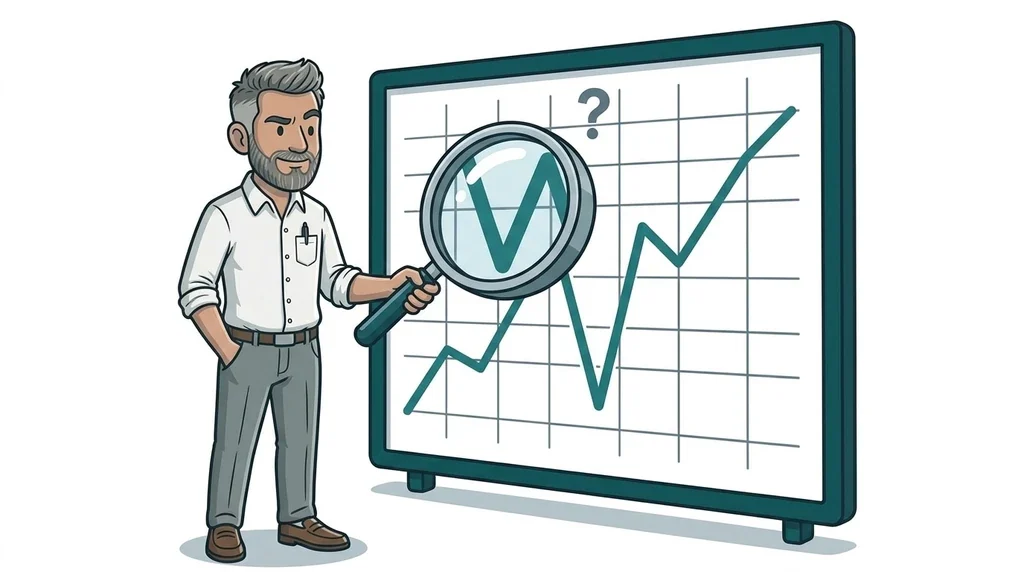
Since late September 2026, Google has been sending some automated SEO tools search results pages with the usual websites swapped out. Rank trackers such as Semrush, SE Ranking, AccuRanker and Nozzle have all confirmed the problem, and it means a ranking report can show your site vanishing from page one for a day when real customers searching on Google still found you exactly where you always are.
If your monthly SEO report or a tool alert has told you that your Google rankings dropped in the last few weeks, do not rewrite your website yet. Check Google Search Console first. It is free, it comes straight from Google, and it reflects what real people actually saw.
What is happening to rank tracking tools?
Rank trackers work by searching Google automatically, thousands of times a day, and recording where each website appears. Google has never liked this. Its own spam policies list scraping results for rank-checking without permission as a breach of its terms.
What changed this autumn is how Google responds. Search Engine Roundtable reported on 12 October that Google is blocking large networks of the addresses these tools use, showing far more CAPTCHA checks, and, most unusually, serving some requests a normal-looking page full of the wrong results. The tool has no way of knowing. As the rank tracking firm Nozzle put it, nothing on the page gives it away.
Google has not commented publicly. Most people in the industry think the real target is AI companies and data resellers that scrape Google at huge scale, with SEO tools caught in the crossfire.
How big is the problem?
The answer depends on which tool you ask, because each one collects data differently. Here are the key figures from the companies that have published their own numbers:
- Nozzle: across 27 million search pages checked since 13 September, 8.4% came back "poisoned", against 0.17% before. The worst day was 29 September at 28.6%, and it has run at 3 to 7% a day since 14 October.
- Your own site disappears: on those poisoned pages, the business being tracked was missing from the top 10 in 60.2% of cases, compared with 2.7% normally.
- Forums and social sites fill the gap: Nozzle found Reddit, Facebook, Instagram, Quora and LinkedIn turning up more often in the swapped results.
- AccuRanker: its data shows a sharp spike starting late on 24 September, peaking at about 30% of desktop checks the next day, then settling to about 1.5% in early October and dropping below 1% by 17 October.
- Semrush: said in a statement that it has seen the issue since late summer, that the impact on users has been limited and that most bad results appear beyond page one.
- SE Ranking: said on 16 October that about 2% of tracked results were still affected and that it had corrected its historical data.
The good news is that most false drops are short. AccuRanker says more than nine in ten poisoned spells last a single day, and Nozzle found the usual sites back within three days in roughly seven cases out of ten.
Why the timing makes this confusing
Google's September spam update ran from 24 September to 8 October, and it caused real ranking changes for some websites. We covered what to do about that in Google's spam update has finished: what to do now.
That overlap is the problem. A drop in your report from late September or early October could be a genuine spam update hit, a blocked check, or a poisoned one. Even experienced SEO specialists said publicly that their trackers were too unreliable to tell the difference at the time. If someone is recommending big changes to your site on the strength of that data alone, it is fair to ask how they know the drop was real.
How to tell a false drop from a real one
Signs it is probably a tracking glitch
- Your position fell sharply for one day, then went straight back.
- Most of your usual competitors vanished from the same results at the same time.
- A local search suddenly lists businesses from another town, which AccuRanker says can happen on a swapped page.
- Your enquiries, calls and sales carried on as normal.
Signs it is probably real
- The drop has lasted a week or more.
- Search Console shows fewer impressions and clicks for the same pages over the same dates.
- Several pages or services fell together, rather than one keyword.
- Enquiries from your website have slowed as well.
How to check your Google rankings in Search Console
Google Search Console records what happened in real searches, so it is the best referee when your tools disagree. If you have not set it up yet, our guide to getting started with Search Console walks you through it.
- Open the Performance report and set the date range to cover the drop, plus the same length of time before it.
- Use Compare to put the two periods side by side.
- Filter by the query your tool flagged, then check the Pages, Countries and Devices tabs.
- Look at impressions and clicks first. If they held steady, the drop was in the tracker's data, not in Google.
- Remember that Search Console runs a couple of days behind and shows an average position, so expect small differences from any tool.
Search Console also now shows how often your pages appear in AI Overviews and AI Mode, which no third-party tracker can measure reliably. We explained how to read that in Search Console now shows AI Overview impressions.
What this means for your business
For most small businesses, the lesson is simple. A ranking position from a third-party tool is an estimate, and right now it is a noisier one than usual. Real business results are what matter: enquiries, calls, bookings and sales, backed up by Search Console's view of what searchers actually saw.
If you pay an agency for SEO, it is reasonable to ask three questions:
- Which rank tracker do you use, and how does it check for swapped results?
- Do your reports compare tracker data with Search Console?
- Are you reporting on leads and sales, or only on positions?
Good agencies will be glad you asked. At GLC Web Solutions, our SEO and GEO services start from Search Console and real enquiries, with tools used as a second opinion rather than the final word.
FAQ
Why did my Google rankings drop overnight?
If the drop lasted a day or two and then reversed, it may be a tracking error rather than a real fall. Since late September, Google has been sending some rank tracking tools swapped results. Check Search Console for the same dates before acting.
Are rank tracking tools accurate right now?
Mostly, but less than usual. Vendors including Semrush, SE Ranking and AccuRanker say they now filter out most swapped pages, yet a small share still gets through, especially beyond page one.
Is Search Console more reliable than SEO tools?
For your own website, yes. Search Console uses Google's own data from real searches. It cannot show competitors' positions, which is where third-party tools still help.
Should I stop paying for a rank tracker?
Not necessarily. Trackers are still useful for spotting trends over weeks and watching competitors. Just treat any sudden one-day change as a prompt to check Search Console, not as proof.
Next step
If a recent report has you worried about your rankings, or you are not sure your website is set up to be measured properly, we are happy to take a look. A quick digital consultancy session can untangle what your data is really saying. And if your site needs more than a tune-up, the easiest first step is our free website offer.
No comments yet