
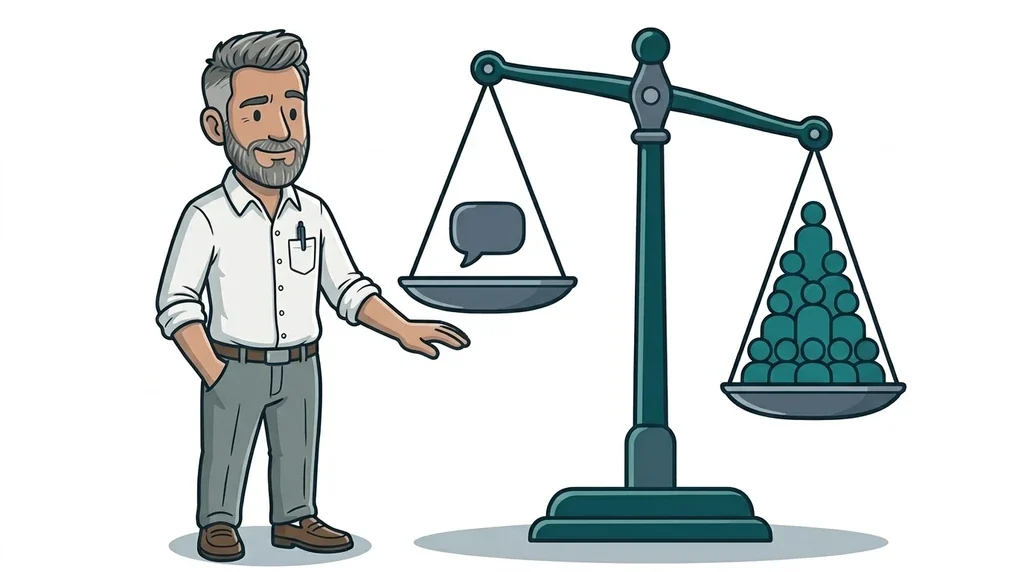
OpenAI says ChatGPT now handles roughly one fifth as many searches as Google. Adam Fry, who leads ChatGPT's consumer product, shared the figure at an OpenAI dinner in New York on Monday 2 November 2026, and Big Technology published the conversation the next day. The traffic data tells a different story. Across 118,671 websites tracked by Ahrefs, Google sent 24.74% of all visits in October 2026 and ChatGPT sent 0.36%, roughly 70 times fewer.
So if you run a small business, the answer to "ChatGPT or Google?" is not one or the other. More of your customers are asking AI tools their questions, but Google is still where most of your website visitors come from. Here is what the numbers mean and what to do about them.
What OpenAI actually said
The key facts:
- Who: Adam Fry, consumer product lead for ChatGPT at OpenAI
- When: Monday 2 November 2026, with the transcript published on 3 November
- The claim: ChatGPT's volume of search-like questions is now about a fifth of Google's
- Also shared: ChatGPT's weekly users grew from 1 billion to 1.2 billion in two months
The detail that matters is how OpenAI counts a search. As Search Engine Journal explains, every time someone asks ChatGPT a question and it goes to the web for the answer, that counts as one search. A single conversation with ten follow-up questions could count as ten. Fry also did not say which Google figure he compared against, what time period it covered or which countries were included.
That does not make the claim wrong. It means it measures something different from what most business owners care about, which is people actually arriving on their website.
ChatGPT vs Google search: questions are not visits
A search is a question. A visit is someone clicking through to your site. ChatGPT answers many questions directly inside the chat, so plenty of its searches never send anyone anywhere.
That is why the visit figures look so different. In October 2026, according to the Ahrefs AI vs search tracker:
- Google sent 24.74% of tracked website traffic
- ChatGPT sent 0.36%
- All AI assistants combined sent 0.46%
Google is not standing still either. In its third-quarter update on 28 October, Google said its year-on-year growth in search queries was the highest in five years. It also said it is building one joined-up experience across AI Overviews, AI Mode and traditional search, and that questions typed into AI Mode are on average three times longer than a normal search.
Put simply, people are searching more overall, in both places, and they are asking longer, more conversational questions.
What it looks like for UK small businesses
Closer to home, Figment's State of AI Search 2026 looked at 21 UK small and mid-sized business websites. Visits from AI assistants rose from 0.83% of traffic in September 2025 to 1.31% in September 2026, and ChatGPT sent 92% of the AI visits it could identify. It is a small sample, and Figment says so, but the direction matches the bigger picture. AI visits are growing quickly from a very small base.
There is a catch hidden in those numbers. When someone clicks a link inside a Google AI Overview or an AI Mode answer, it shows up as an ordinary Google visit. So your "Google traffic" now includes some AI traffic, and Google's own AI features are quietly doing a lot of the work. We explained how to see part of that picture in our post on the Search Console AI Overview report, and why Google's AI answers now link to more websites.
What this means for your business
- Keep Google as your foundation. For most local and service businesses, Google search and a complete Google Business Profile still bring in the bulk of new visitors. Do not abandon solid SEO for a newer channel.
- Make your website easy for AI tools to quote. The things that help ChatGPT recommend you are the same things that help Google's AI answers. That means clear service pages, prices or price guides where you can give them, the areas you cover, opening hours and plain answers to the questions customers actually ask. Our guide to optimising your website for GEO walks through this step by step.
- Expect AI visitors to arrive ready to act. People often ask an AI tool for a shortlist, then check the business website before getting in touch. We looked at that behaviour in more customers ask AI to find a local business, then check you out. Your site has to confirm what the AI said, quickly and clearly.
- Do not block the tools that answer customers' questions. Opting out of AI training is a separate decision from appearing in AI answers. Our post on the new AI training opt-out in robots.txt explains the difference.
How to see ChatGPT traffic in Google Analytics
If you use Google Analytics 4, you can check how many visitors ChatGPT really sends you.
- Open Reports, then Acquisition, then Traffic acquisition.
- Look for the AI Assistant channel. Google describes it as visits from tools such as ChatGPT, Gemini, DeepSeek, Copilot and Grok. It does not include Google's own AI Overviews or AI Mode, which are counted under Organic Search.
- To see ChatGPT on its own, filter Session source to chatgpt.com.
One warning if you are comparing October reports. Between about 8 and 16 October 2026, links in ChatGPT answers lost their tracking tag, so many of those visits were recorded as Direct instead. Search Engine Roundtable reported that this was later confirmed as a bug. If your ChatGPT numbers dipped in mid-October, that is the likely reason, not a real drop in interest.
If you would rather someone else made sense of these reports and turned them into a plan, that is the kind of work our digital and AI consultancy covers.
FAQ
Is ChatGPT replacing Google search?
Not yet. OpenAI says ChatGPT handles about a fifth as many search-like questions as Google, but Google still sends around 70 times more visits to websites, and Google says its search growth is the fastest it has been in five years.
How much traffic does ChatGPT send to websites?
On average, very little so far. Across the 118,671 sites tracked by Ahrefs in October 2026, ChatGPT sent 0.36% of visits. On a small sample of UK business websites, Figment found all AI assistants together sent around 1.3%.
Should my small business focus on ChatGPT or Google?
Both, through the same work. Clear, accurate, well-structured website content and a complete Google Business Profile help you appear in Google results, in Google's AI answers and in ChatGPT recommendations.
Why does ChatGPT traffic show as Direct in Google Analytics?
It happens when a click from ChatGPT arrives without its tracking tag and without information about where it came from. That happened widely between about 8 and 16 October 2026 because of a bug, which has since been fixed.
The short version
ChatGPT is now a real place where your customers ask questions, and that share is growing fast. Google is still where most of them click through to a website, and Google's own AI features are blurring the line between the two. The good news is that you do not need two separate strategies. A fast, clear website that answers customers' questions well works for both, backed by sensible SEO and GEO.
If this has you wondering whether your own site gives Google and AI tools what they need, an easy first step is our free website offer. We will look at where you stand and what would make the biggest difference, so you can get back to running your business.

No comments yet